

Cracks Around Windows on the Facade: Possible Causes and Repair Methods
Have you noticed cracks on the facade around the windows? This is one of the most common problems faced by building owners. And for good reason — the corners of window and door openings are among the most vulnerable spots in any structure. Cracks around windows on the facade are not just an aesthetic defect that ruins the building’s appearance. They are a signal that processes are taking place in the structure that could lead to serious consequences: from reduced energy efficiency to a breach in the integrity of the entire building. Understanding the nature of these cracks helps take timely measures and avoid significant financial losses.
Why Cracks Appear Around Windows on the Facade
Window and door openings are natural “weak spots” in a building’s structure. It is here that the greatest stresses occur during any deformation. There can be several reasons for the appearance of cracks near windows, and they often act in combination:
- Uneven foundation settlement — one of the most common causes. If the soils under different parts of the building have different load-bearing capacities, stresses arise that tear the walls precisely at the opening locations. Structural shifting or uneven settlement cause stress in these areas. While uniform settlement is a normal process, uneven settlement leads to cracks.
- Thermal deformations — significant temperature fluctuations cause materials to expand and contract. If expansion joints are missing in the design, stresses occur that tear the material. Poor-quality insulation often leads to temperature fluctuations that cause facade materials to expand and contract.
- Soil subsidence — washing away of soil particles from under the foundation leads to building movement and cracks.
- Building shrinkage — a natural process that occurs in the first years after construction. Especially noticeable in new buildings.
- Window installation technology violations — incorrect window block installation, insufficient filling with mounting foam, absence of reinforcement in the opening zone.
- Structural overloading — adding floors, installing heavy equipment without prior load-bearing capacity calculation.
How to Assess the Risk of Cracks Around Windows
Not all cracks are equally dangerous. For proper risk assessment, you should pay attention to several key characteristics:
- Crack width — cracks less than 1 mm wide are usually not critical. If the width exceeds 2–3 mm, it is already an alarming signal.
- Development dynamics — the main indicator of danger. If a crack increases in width or length over time, it indicates progressive structural deformation. Monitoring is done using control beacons.
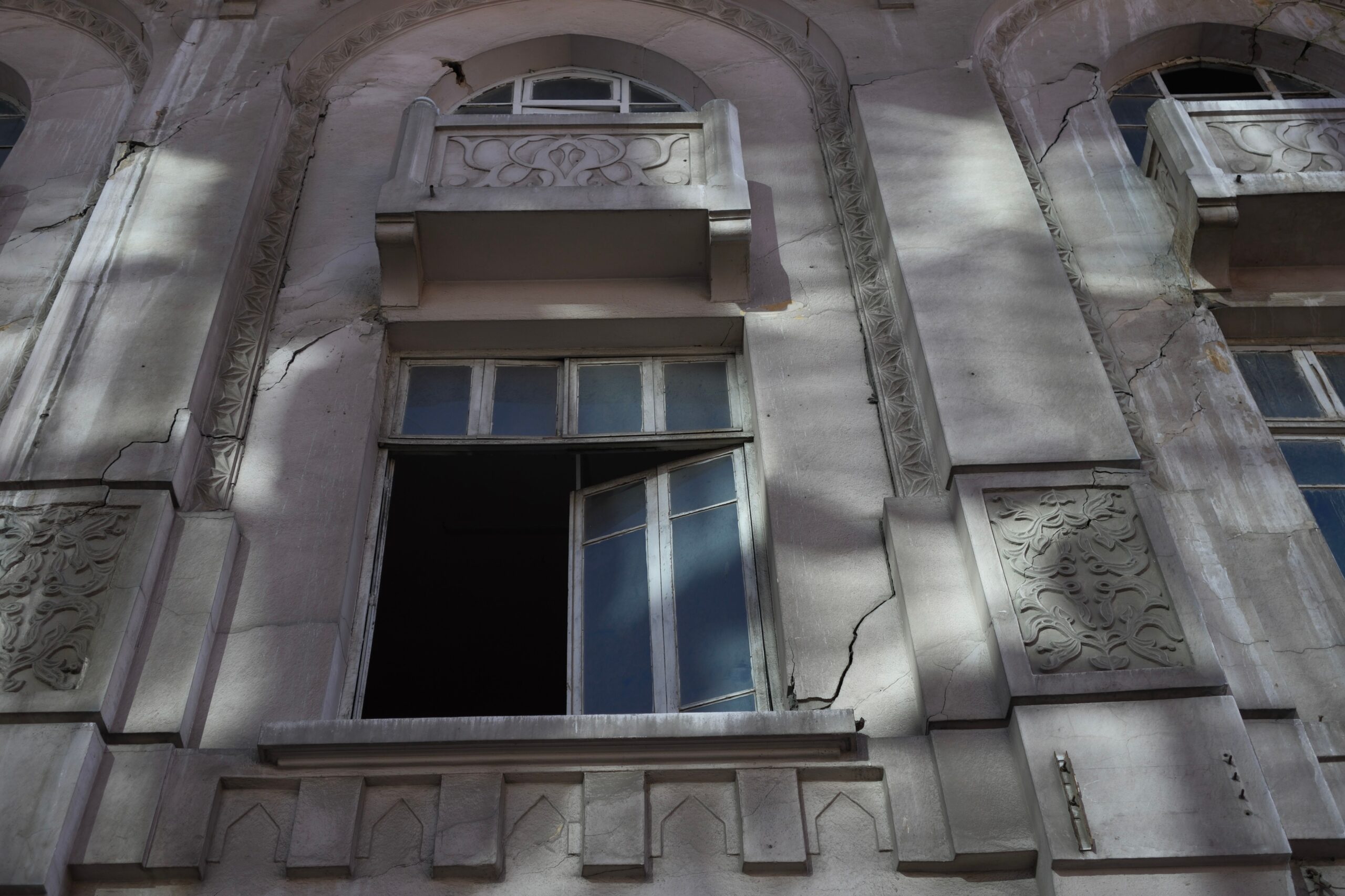
- Crack nature — through-cracks (passing through the entire wall thickness) are significantly more dangerous than surface ones. Cracks diverging from the corners of openings at a 45-degree angle most often indicate uneven settlement.
- Location — cracks in the window opening zone on load-bearing walls are more dangerous than those on non-load-bearing partitions.
Regular inspection of the facade for micro-cracks, especially after heavy rain or frost, makes it possible to avoid further development of the problem. Professional technical facade inspection allows accurately determining the cause of cracks near windows and assessing the degree of danger to the building.
Consequences of Ignoring Cracks Around Windows
If measures are not taken in time, cracks can lead to serious problems:
- Moisture penetration — water enters the structures through cracks, causing insulation dampness, reinforcement corrosion, and material destruction.
- Thermal bridge formation — cracks create paths for heat to escape, leading to increased heating costs.
- Breach in window airtightness — deformation of walls around windows can lead to skewing of window blocks, disrupting their operation and causing additional heat loss.
- Progressive destruction — if the cause is not eliminated, cracks will expand, leading to more serious structural damage.
Comprehensive building inspection helps identify hidden defects and avoid significant financial expenses in the future.
How to Repair Cracks Around Windows
The choice of repair method depends on the cause and degree of damage:
- Cosmetic repair — filling surface cracks with a repair compound. Suitable for stable cracks up to 1-2 mm wide that are not progressing.
- Chasing and filling — for deeper cracks: the crack is widened, primed, and filled with a special repair compound, followed by reinforcement.
- Eliminating the cause — if cracks are caused by uneven foundation settlement, strengthening the building’s base is necessary.
- Opening zone reinforcement — installing additional reinforcement elements or metal ties in cracked areas.
- Window block replacement — if wall deformation has damaged the window.
It is important to remember: cosmetic crack sealing without eliminating the root cause only masks the problem rather than solving it. Technical inspection of buildings and structures allows determining the cause of deformation and developing an effective restoration plan.
Frequently Asked Questions
Can I seal a crack near a window myself?
Cosmetic sealing of small surface cracks is possible, but it won’t solve the problem if the crack is a consequence of structural deformation. If the foundation continues to settle, the crack will reappear. It is necessary to first conduct an inspection and eliminate the root cause.
How to distinguish a dangerous window crack from a safe one?
The main criterion is dynamics. Install a control beacon (a strip of plaster or paper across the crack). If the beacon doesn’t break within 1-3 months — the crack is likely stable. If the beacon ruptures or the crack expands — this is a signal of progressive deformation requiring professional intervention.