

Soil Settlement Near the Foundation: Causes, Dangers, and Repair Methods
Have you noticed that the soil near the foundation has started to settle, and depressions or cracks have appeared on the walls? This may be a sign of soil settlement — a process that poses a serious threat to the entire building. Soil settlement near the foundation leads to a loss of support for the structure, uneven distribution of loads, and, consequently, cracks, distortions, and even building collapse. The most dangerous aspect is that this process often occurs unnoticed until it is too late.
Why Soil Settlement Occurs Near the Foundation
Soil settlement is the vertical movement of the earth’s surface due to soil compaction under the weight of a building or a change in its properties. The reasons for this phenomenon can be various:
- Loss of moisture in clay soils — upon drying, clay soils decrease in volume, leading to “subsidence” and loss of support for the foundation.
- Soil erosion by water — water accumulating near the foundation washes away soil particles, creating voids and reducing the base density.
- Excessive soil wetting — upon a change in groundwater levels or flooding, the soil loses its load-bearing capacity.
- Construction technology violations — insufficient soil compaction before construction, incorrect choice of foundation type, failure to account for soil properties.
- Changes in hydrogeological site conditions — nearby construction, change in groundwater levels, damage to drainage systems.
Collapsible soils are especially dangerous, as they quickly change their structure and lose load-bearing capacity upon excessive wetting.
How Soil Settlement Affects the Building
Soil settlement near the foundation is a process that has serious consequences:
- uneven foundation settlement — if the soil under different parts of the house settles differently, stresses arise that lead to cracks;
- structural deformation — cracks in walls, distortions in door and window openings, settlement of the ground floor;
- loss of foundation load-bearing capacity — with significant soil settlement, the foundation can lose its support, which will lead to its destruction;
- damage to engineering systems — foundation deformation entails damage to water supply pipes, sewage, and gas pipelines;
- risk of collapse — in critical cases, uneven settlement can lead to partial or total collapse of the building.
When permissible settlement limits are exceeded, there is a threat of damage and destruction to the house’s structural elements. If there is damage to structural elements, and the cause of this damage is excessive foundation settlement, it is necessary to carry out repair work not only to eliminate the damage itself but also to eliminate the cause of its appearance.
How to Detect Soil Settlement Near the Foundation
Timely detection of the problem allows avoiding significant repair costs. Here is what to pay attention to:
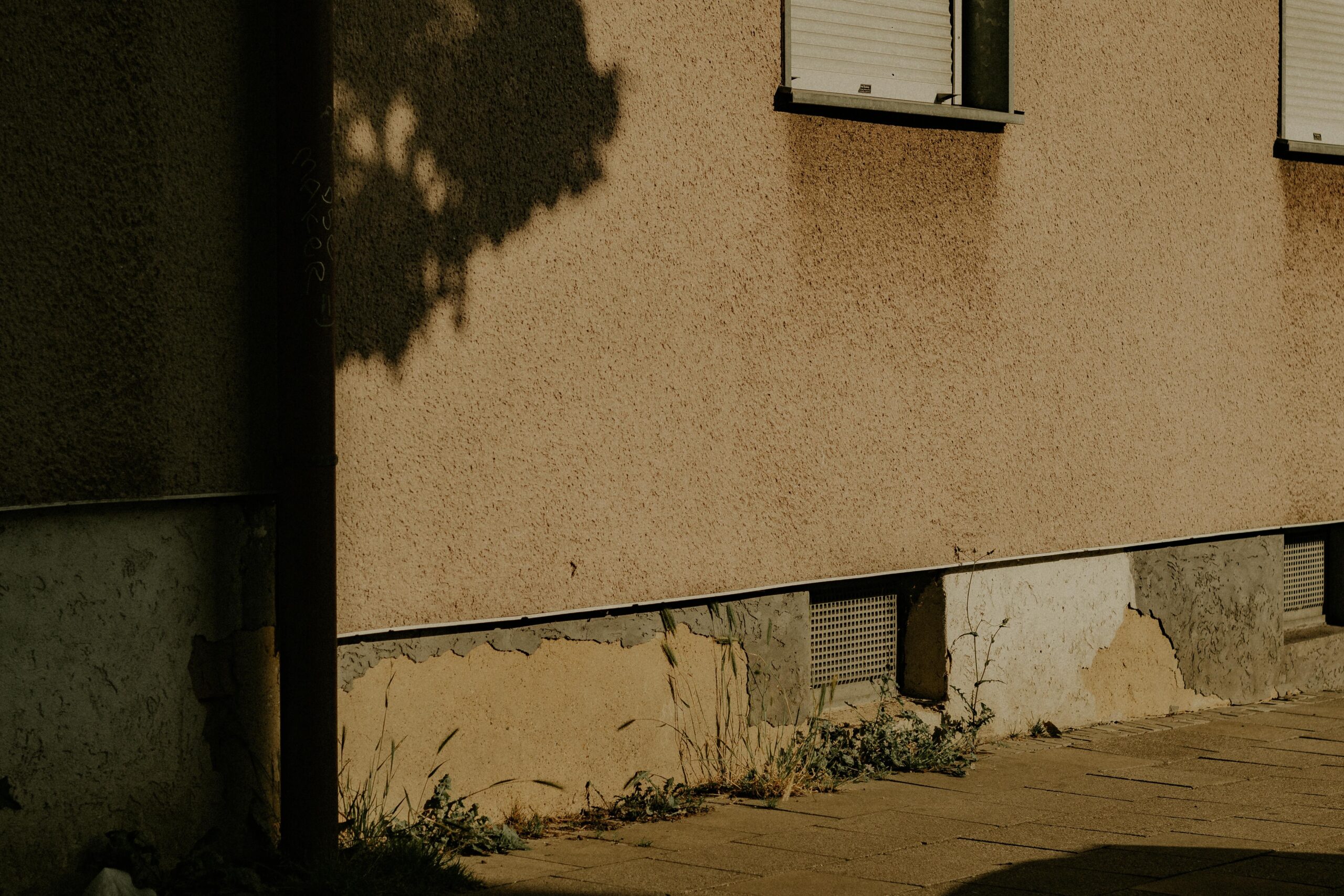
- soil settlement near the foundation — appearance of depressions, cracks in the soil, soil pulling away from the foundation;
- cracks on walls — especially diagonal cracks diverging from the corners of window and door openings;
- distortions of door and window openings — doors and windows stop closing, gaps appear;
- ground floor settlement — the floor becomes uneven, cracks appear;
- water accumulation near the foundation after rain — a sign of improper water drainage.
For precise diagnostics, specialists conduct a comprehensive inspection, which includes assessing the foundation condition, soil analysis, and geodetic measurements of vertical and horizontal structural deformations. Foundation inspection may be necessary in cases where building deformations or settlement are detected.
How to Eliminate Soil Settlement Near the Foundation
The choice of elimination method depends on the cause and degree of settlement:
- Geopolymer resin injection — a modern method that allows stopping settlement by strengthening the soil without large-scale earthworks.
- Soil compaction — injecting cement-based concrete mortar into soil pores to compact and bind particles.
- Drainage system restoration — ensuring proper water diversion from the foundation to prevent soil erosion and waterlogging.
- Foundation strengthening — increasing foundation width, installing additional supports.
- Soil replacement — in cases where the soil has completely lost its load-bearing capacity.
It is important to remember: cosmetic repair of cracks without eliminating the cause of settlement will be ineffective. It is necessary to first stop the settlement process and then restore the damaged structures.
Prevention of Soil Settlement
It is much easier to prevent settlement than to spend money on eliminating it:
- Conducting engineering-geological surveys before construction — this allows accounting for soil properties and choosing the correct foundation type.
- Ensuring proper water drainage — timely water diversion from the foundation prevents soil erosion.
- Monitoring the soil condition near the foundation — regular inspection allows detecting the first signs of settlement.
- Conducting periodic technical inspections — planned inspections allow identifying problems before they become critical.
Frequently Asked Questions
Can I independently determine if the soil near the foundation is settling?
Yes, you can notice visual signs: soil subsidence, cracks on walls, door and window distortions. However, for a precise assessment of the scale of settlement and its causes, a professional inspection with instrumental measurements is required.
How long does the soil settlement process last?
Foundation settlement is a phenomenon that occurs within 3–5 years after building construction is completed. However, upon a change in hydrogeological conditions (flooding, soil drying), the process can activate at any moment.