

Roof Deformation: What It Means
Roof deformation is one of the most alarming signals indicating serious problems in the structure. Unlike local damage (cracks, delamination), deformation points to a change in the geometry of the entire roofing system or its individual elements. This can be sagging, warping, settlement, or displacement. Understanding the causes and consequences of roof deformation helps take timely action and avoid catastrophic consequences.
What Is Roof Deformation and What Are Its Types
Roof deformation is a change in the shape or dimensions of structural elements under external loads. The most common types of deformations:
- Sagging (Deflection) — warping of roof elements (rafters, beams, floor slabs) under vertical load. Sagging can be uniform or local.
- Settlement — vertical movement of individual roof sections due to base settlement or loss of element load-bearing capacity.
- Warping — a change in the straightness of roof elements, which can be caused by uneven heating, moisture, or mechanical impacts.
- Displacement — horizontal movement of roof elements relative to each other or relative to load-bearing walls.
- Blistering — local bulging of the roofing material, often arising from moisture or vapor accumulation under the waterproofing layer.
Professional roof inspection allows accurately determining the type of deformation and assessing its impact on building safety.
Causes of Roof Deformation
Roof deformation can be caused by various factors, which often act in combination:
- Exceeding design loads — excessive snow loads, installation of additional equipment on the roof (solar panels, air conditioners, antennas) without prior load-bearing capacity calculation.
- Foundation settlement — uneven settlement of the building’s base leads to warping of the entire structure, including the roof.
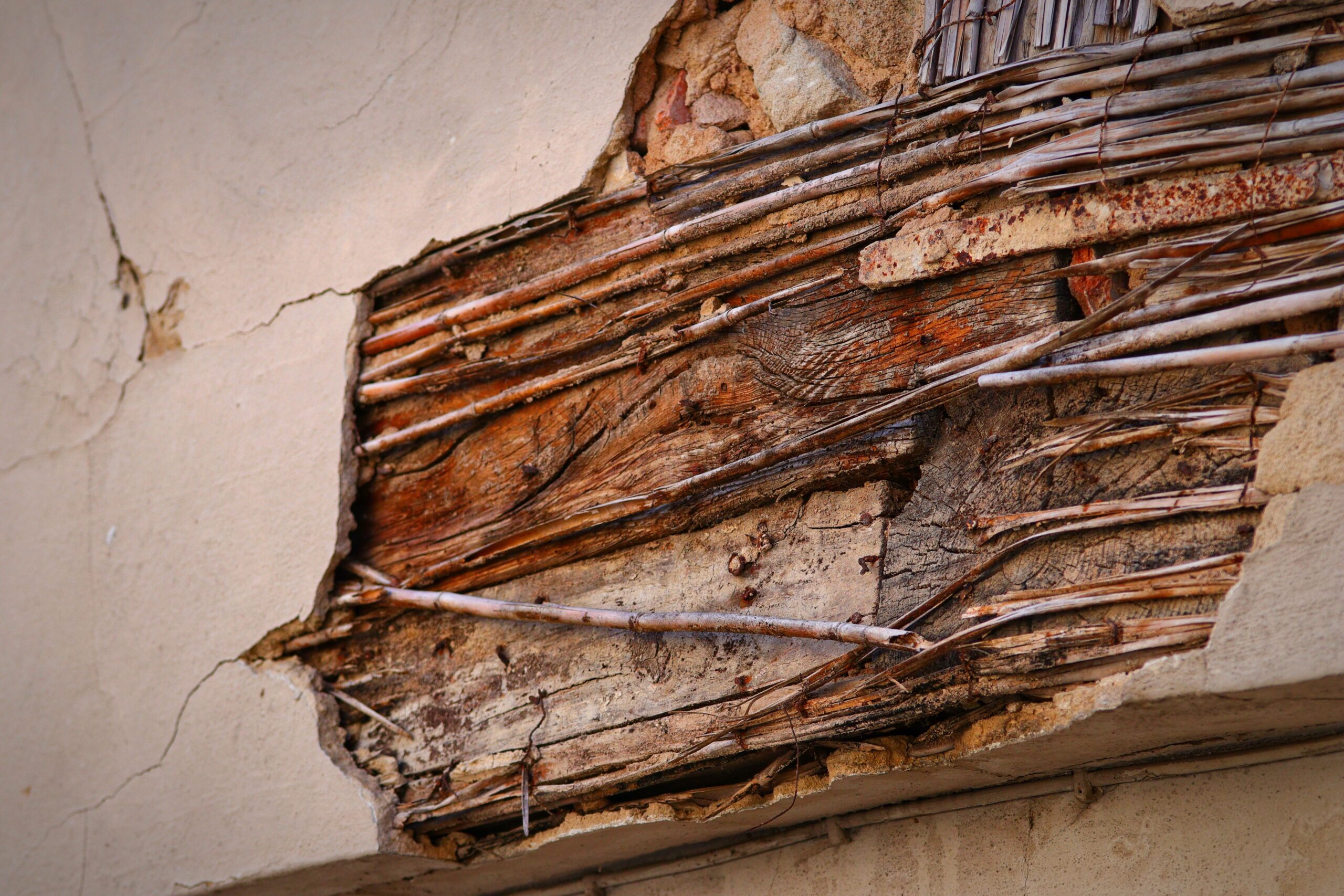
- Dampening and rotting of wooden elements — for wooden roofs, this is one of the most common causes of deformation. Moisture destroys the wood structure, reducing its strength.
- Corrosion of metal elements — rust reduces the cross-section of metal beams, fasteners, and other elements, leading to loss of load-bearing capacity.
- Thermal deformations — significant temperature fluctuations cause materials to expand and contract, which can lead to warping and cracks.
- Improper installation — violation of roofing technology, insufficient fastening of elements, absence of expansion gaps.
Consequences of Roof Deformation for the Building
Roof deformation is not just an aesthetic problem. It can have serious consequences for the entire building:
- Loss of airtightness — deformation leads to opening of joints and cracks, creating paths for moisture penetration.
- Reduced load-bearing capacity — progressive deformation can lead to the loss of load-bearing capacity of individual elements or the entire roofing system.
- Destruction of roofing cover — base deformation causes damage to roofing material — cracks, tears, delamination.
- Damage to interior premises — leaks resulting from deformation lead to damage to ceilings, walls, and finishes.
- Collapse threat — in critical cases, deformation can lead to partial or total roof collapse.
Technical inspection of buildings and structures helps assess the degree of deformation danger and develop a plan for its elimination.
How to Detect Roof Deformation
Timely detection of deformation is the key to preventing serious consequences. Here is what to look for:
- visual signs — warping of roof lines, waves on roofing cover, visible sags, tilting of individual sections;
- internal signs — cracks on ceilings and walls of upper floors, traces of leaks, deformations of door and window openings;
- attic signs — warped rafters, traces of settlement, disruption of structural geometry;
- drainage issues — water accumulation in places where there was none before can indicate deformation and change in slopes.
For accurate assessment of deformation, instrumental methods are used — geodetic measurements, laser scanning, leveling.
Methods for Eliminating Roof Deformation
The choice of deformation elimination method depends on its cause and degree of damage:
- structural reinforcement — installing additional supports, strengthening rafters, beams, trusses;
- replacing damaged elements — in cases where individual elements have lost load-bearing capacity;
- roof leveling — installing an additional layer to restore slopes and geometry;
- repair or replacement of roofing — after eliminating base deformation;
- foundation strengthening — if roof deformation is caused by building base settlement.
Professional technical inspection allows determining the optimal method for eliminating deformation and avoiding repeated damage.
Frequently Asked Questions
Can roof deformation lead to building collapse?
Yes, if deformation progresses and measures for structural reinforcement are not taken. Particularly dangerous are deformations of load-bearing elements (rafters, beams, trusses), which can lead to loss of load-bearing capacity of the entire roofing system.
How often should the roof condition be checked for deformations?
It is recommended to perform a visual inspection at least twice a year, as well as after significant loads (heavy snowfall, hurricanes). Professional inspection with instrumental measurements is recommended every 5–10 years.