


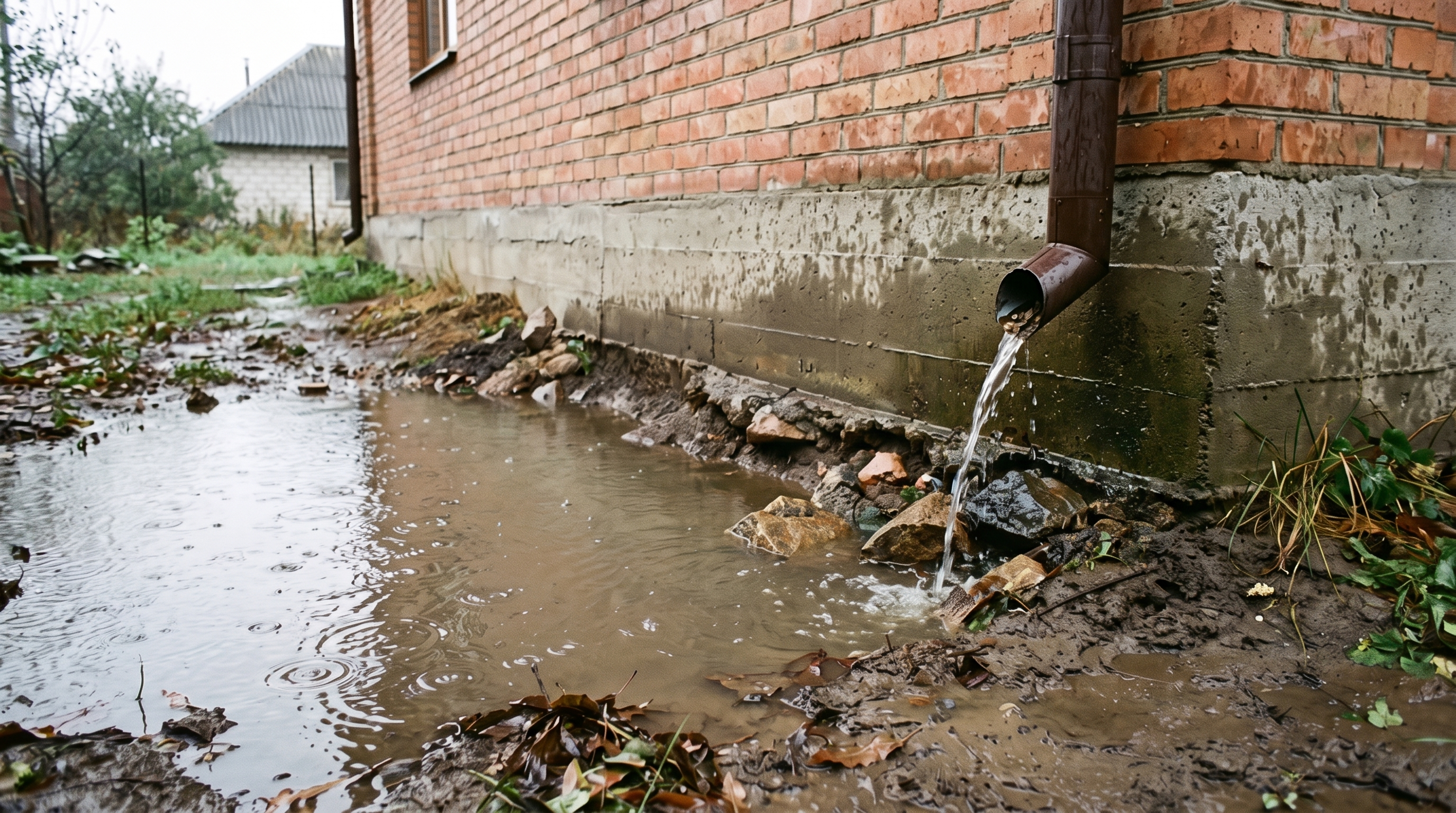
Water Near the Foundation After Rain: Why It Is Dangerous and How to Solve the Problem
After the latest downpour, do you see puddles near your house walls that take a long time to dry? Standing water near the foundation is not just a minor inconvenience, but a serious threat to the entire building. Constant moisture at the base leads to concrete degradation, rebar corrosion, flooded basements, and even uneven settlement of the entire structure. Understanding the causes of water accumulation near the foundation and timely addressing these issues is the key to your home’s longevity.
Why Water Remains Near the Foundation After Rain
If water constantly accumulates near the base of the building, the cause is likely rooted in one of the following factors:
- Absence or damage to the apron/pavement — if the perimeter pavement is missing, cracked, or lacks sufficient slope, water from the roof and surrounding area flows directly to the foundation.
- Clogged or improperly installed gutter system — gutters and downspouts clogged with leaves cannot effectively divert water, causing it to overflow and accumulate near the walls.
- Disrupted soil grading — improper site planning (lack of correct slope) causes water to stagnate near the foundation instead of flowing away.
- Absence of a drainage system — in areas with high groundwater levels or clay soils, water has nowhere to go after rains without a drainage system.
- Soil subsidence — over time, the soil around the house can settle, creating depressions where water collects.
Why Water Accumulation Near the Foundation Is Dangerous
Constant moisture at the base of a building triggers a chain of destructive processes. The consequences can be critical:
- Concrete and brickwork degradation — water penetrating the pores of materials expands upon freezing, gradually destroying them from the inside.
- Rebar corrosion — moisture reaching the foundation’s metal elements causes rust, which expands in volume and cracks the concrete.
- Basement flooding — through micro-cracks and capillaries, water penetrates inside, creating dampness, mold, and unpleasant odors.
- Uneven building settlement — wet soil erodes and loses its load-bearing capacity, which can lead to cracks in walls and distortions.
- Foundation frost heave — moisture-laden soil freezes deeper in winter, creating additional pressure on the structure.
According to construction standards, the design of foundations must include protection against groundwater and atmospheric precipitation.
How to Eliminate the Problem of Water Near the Foundation
The choice of elimination method depends on the cause of water accumulation. The most effective solutions include:
- Restoration or installation of perimeter apron — a concrete or asphalt apron at least 1 meter wide with a slope away from the building (2–3%) ensures water diversion.
- Repair and cleaning of the gutter system — regular cleaning of gutters and downspouts, fixing damage, and extending downspouts to divert water at least 1.5–2 meters away from the foundation.
- Installation of a drainage system — in cases of high groundwater or heavy soils, a deep drainage system is necessary to divert water from the foundation.
- Foundation waterproofing — applying waterproofing materials (coatings, membranes, penetrants) to create a watertight barrier.
- Raising the ground level — if the site has an incorrect slope, adding soil to create a proper drainage path may be possible.
Comprehensive technical building inspection allows for accurately determining the cause of water accumulation and developing an effective mitigation plan.
Prevention of Water Accumulation Near the Foundation
It is much easier to prevent a problem than to spend money on eliminating its consequences:
- regularly check the state of the apron and gutter systems — at least twice a year (spring and autumn), as well as after heavy rains;
- timely clean gutters and downspouts of leaves, branches, and debris;
- monitor the soil condition around the building — if depressions or cracks appear, add and compact soil in a timely manner;
- conduct periodic technical inspections of the foundation to detect hidden defects.
Inspection of walls and building foundations is a key stage in ensuring the safety and reliability of facility operation.
Frequently Asked Questions
Can the problem of water near the foundation be solved independently?
Minor issues (e.g., cleaning gutters or minor repairs to the apron) can be handled independently. However, if the problem is caused by high groundwater or requires a drainage system installation, professional intervention is necessary.
How often should the drainage system near the foundation be checked?
It is recommended to inspect the system at least twice a year, as well as after heavy downpours. Particular attention should be paid to areas where water accumulates most frequently.