


Concrete Spalling on Floor Slabs: Causes, Dangers, and Diagnostic Methods
Have you noticed areas on your ceiling or floor where the concrete is spalling, exposing the reinforcement? This is not just an aesthetic defect — it is a warning sign of serious problems within the floor structure. Concrete spalling on floor slabs can lead to loss of load-bearing capacity, reinforcement corrosion, and even building collapse.
What Is Concrete Spalling and Why Does It Occur
Concrete spalling is a process where the protective concrete cover separates from the main structural element or the reinforcement. It is one of the most dangerous defects, as it not only reduces the floor’s strength but also exposes the reinforcement to moisture, which accelerates corrosion. Main causes of concrete spalling:
- Reinforcement corrosion — the most common cause. Rust occupies a larger volume than metal, effectively rupturing the concrete from within. This is especially dangerous for floor slabs subjected to constant loads.
- Improper concreting technology — incorrect water-to-cement ratios (too much water and too little cement) can lead to the spalling of the top layer.
- Differential water-cement ratio — the surface layer (1–3 cm) may have a different composition than the bulk concrete, leading to delamination.
- Floor overloading — when structural elements reach their capacity, it can trigger spalling.
- Concrete freezing — water trapped in pores expands upon freezing, destroying the material structure.
- Improper reinforcement preparation — contaminants or oil stains on the rebar impair its bond with the concrete.
Why Concrete Spalling Is Dangerous
Concrete spalling is more than a cosmetic defect. Its danger lies in several aspects:
- Loss of load-bearing capacity — spalling reduces the effective cross-section of the floor, causing the structure to fail under design loads.
- Reinforcement corrosion — exposed steel is subjected to moisture and oxygen, leading to corrosion. Expanding rust continues to destroy the concrete.
- Progressive failure — spalling tends to expand. Without timely intervention, the defect will affect increasingly larger areas.
- Risk of collapse — in critical cases, spalling can lead to structural failure of the slab.
It is important to understand: concrete spalling does not occur suddenly. It begins with micro-cracks that gradually widen. That is why identifying the first signs of the defect is crucial.
How to Identify Concrete Spalling on Floor Slabs
The first signs of spalling can be identified during visual inspection:
- surface bulges or protrusions — areas where the concrete has risen above the general surface level;
- dull sound during tapping — tapping the surface with a hammer reveals a hollow or dull sound in spalled areas;
- cracks and crack patterns — especially around areas where spalling is beginning;
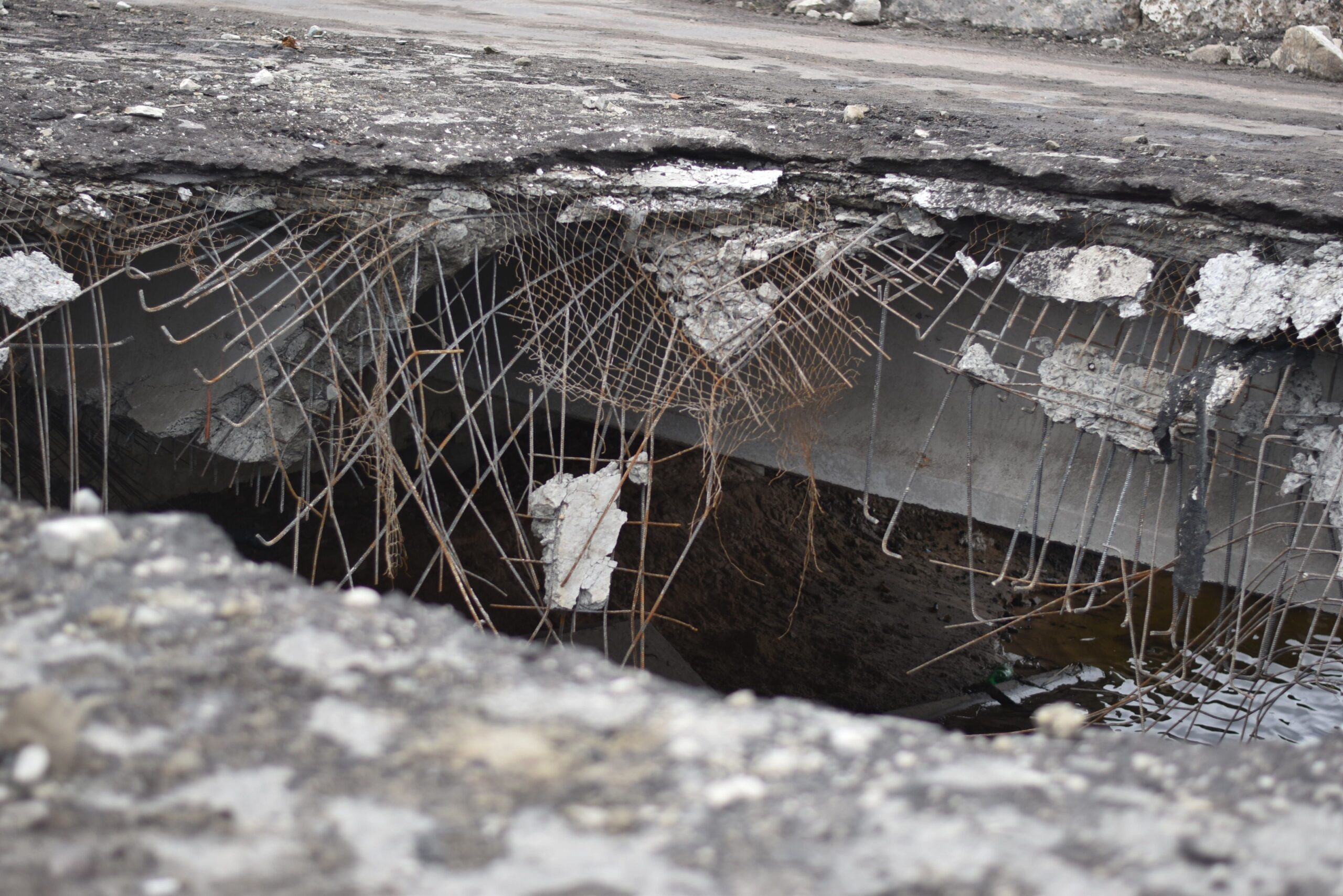
- exposed reinforcement — visible steel rods protruding from the concrete;
- rust stains — brown marks on the concrete surface indicating reinforcement corrosion;
- spalls and pits — areas where the concrete has already detached.
If you notice any of these signs, do not hesitate. Professional inspection of building floor systems will help determine the scale of the problem and develop a repair plan.
How Diagnosis and Condition Assessment Are Conducted
Professional inspection of floors showing signs of spalling is conducted in accordance with DBN V.1.2-14:2018 requirements and current legislation. Specialists perform a comprehensive set of works:
- Visual inspection — assessing the condition of slabs and joints, and identifying visible defects and damage.
- Instrumental measurements — determining deflections, crack width, and assessing reinforcement condition.
- Non-destructive and selective destructive testing — using ultrasonic methods and sclerometry to determine concrete strength.
- Sampling materials — for laboratory analysis of concrete composition and properties.
- Determining actual load-bearing capacity — calculating the residual strength of the structure.
- Compiling a technical report — including conclusions and recommendations for repair or strengthening.
Methods for Eliminating Concrete Spalling
The choice of repair method depends on the extent of the damage:
- local spalling — removing damaged concrete, cleaning rust from reinforcement, and applying repair mortar;
- significant spalling — shotcreting (applying concrete under pressure), installing additional reinforcement, and strengthening with composite materials;
- critical damage — full replacement of the floor slab section or strengthening with steel beams.
Technical inspection of buildings and structures is the first step toward the safety of your building.
Frequently Asked Questions
Can I repair concrete spalling myself?
Small local areas can be repaired independently, but if the spalling is widespread or accompanied by reinforcement corrosion, professional intervention is necessary. Improper repairs can accelerate structural degradation.
How can concrete spalling be prevented?
Prevention includes: timely repair of cracks, protecting reinforcement from moisture, monitoring floor loads, and regular technical inspections.